Imagine you are looking for a company online.
You find their website through Google, click the link and land on a page that looks outdated, takes too long to load, has tiny text, confusing navigation and no clear explanation of what the business actually does.
Would you trust the company enough to contact them?
Probably not.
Now imagine the opposite. The website loads quickly, the information is organised clearly, the visual design feels professional, the brand looks consistent and you immediately understand what the business offers and where you need to click next.
That difference is the power of good website design.
Website design is not simply about choosing attractive colours, adding animations or making a homepage look modern. A well-designed website brings together visual communication, branding, user experience, responsive design, content structure and business objectives.
For a business, your website often becomes the first impression a potential customer has of your brand. And in many cases, that first impression happens before anyone from your company gets the opportunity to speak to them.
So, what actually makes website design important?
Let’s look at ten ways a well-designed website can influence how people perceive, understand and interact with your business.
1. Your Website Creates the First Impression of Your Brand
People form opinions quickly.
When someone lands on your website for the first time, they immediately begin making assumptions about your business based on what they see.
Is the company professional?
Does it look established?
Does it appear trustworthy?
Does the business understand its customers?
Is the website easy to use?
These questions may never be consciously asked, but the visitor is still making a judgement.
This is why professional website design is closely connected to brand perception.
A website with a strong visual identity, thoughtful typography, consistent spacing and clear messaging can make a business feel considerably more credible.
On the other hand, a poorly structured website can make even an excellent business appear less established than it actually is.
Your website does not need to be complicated to create a strong first impression. In fact, some of the best websites are remarkably simple.
The difference is that every element has a purpose.
2. Good Design Makes Your Business Easier to Understand
One of the biggest mistakes in website design is trying to say everything at once.
A business may have dozens of services, years of experience, multiple achievements and a long list of reasons why customers should choose them.
Putting all of that information onto the homepage does not necessarily make the website more convincing.
It can actually make it harder to understand.
Good website design creates a hierarchy of information.
The visitor should be able to understand the most important message first, followed by supporting information and finally the details they may want to explore further.
For example, a professional services company might structure its homepage around:
What we do.
Who we help.
Why choose us.
What we have achieved.
How we work.
How to get started.
The design then supports this hierarchy through typography, spacing, layout, imagery and calls to action.
This is where UI/UX design becomes particularly important.
The user interface determines how information is presented, while user experience considers how easily someone can navigate and complete their intended task.
Good design makes both feel effortless.
3. Design Can Build Trust Before the First Conversation
Trust is one of the most important factors in a buying decision.
This is especially true for businesses selling expensive services.
A potential client may be willing to spend ₹50,000, ₹1 lakh or several lakhs on a project, but they will often research the company extensively before making contact.
Your website becomes part of that evaluation process.
Professional photography, strong case studies, testimonials, clear service descriptions, consistent branding and a polished interface can all contribute to perceived credibility.
This doesn’t mean design should be used to make a business appear bigger than it is.
Instead, the website should accurately communicate the quality of the business that already exists.
A strong website should make a visitor think:
“These people understand what they are doing.”
That is much more valuable than simply making them think:
“This website looks cool.”
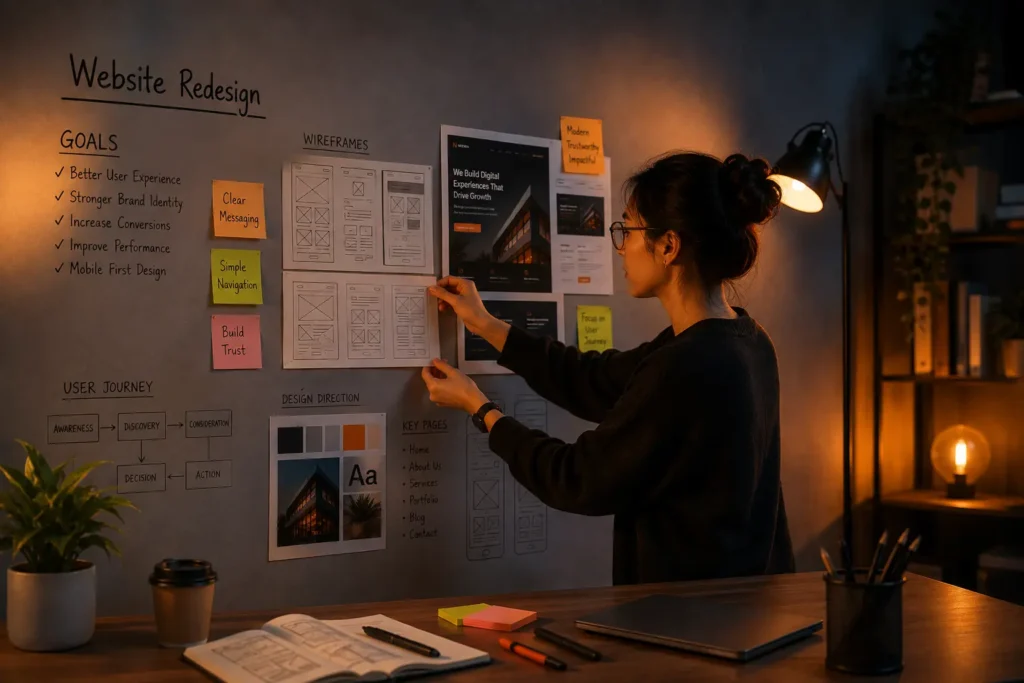
4. Good Website Design Guides People Towards Action
A website has a purpose.
For one business, the goal may be generating enquiries.
For another, it could be selling products.
A SaaS company may want visitors to start a free trial.
A consultant may want visitors to schedule a discovery call.
An architect may want potential clients to view a portfolio and request a consultation.
Good website design helps visitors move towards that goal.
This is where calls to action become important.
A call to action does not always need to say “Buy Now.”
Depending on the business, it could be:
“Book a Consultation”
“View Our Work”
“Get a Quote”
“Explore Services”
“Schedule a Call”
“Start Your Project”
The important thing is that the visitor should never have to wonder what to do next.
A conversion-focused website does not force people to take action. It makes the next step obvious.
5. Visual Hierarchy Makes Websites Easier to Scan
Most people do not read websites word by word.
They scan.
They look at headings, images, highlighted information, buttons and short sections before deciding whether the page deserves more attention.
This is why visual hierarchy is such an important part of modern website design.
A good visual hierarchy helps users understand:
What is most important?
What should I read first?
Where should I look next?
What can I ignore for now?
Typography plays a major role here.
A large heading establishes importance. A smaller subheading provides context. Body text provides detail. A contrasting button creates an obvious action.
Spacing also matters.
When everything is crowded together, nothing feels important.
When the layout has enough breathing room, the content becomes easier to process.
Good design is therefore not about filling every available space.
Sometimes, the best design decision is simply leaving something out.
6. Responsive Design Is No Longer Optional
A website might look fantastic on a desktop and still deliver a poor experience to mobile users.
That is a problem.
People browse websites on phones while travelling, shopping, researching businesses, comparing services and communicating with companies.
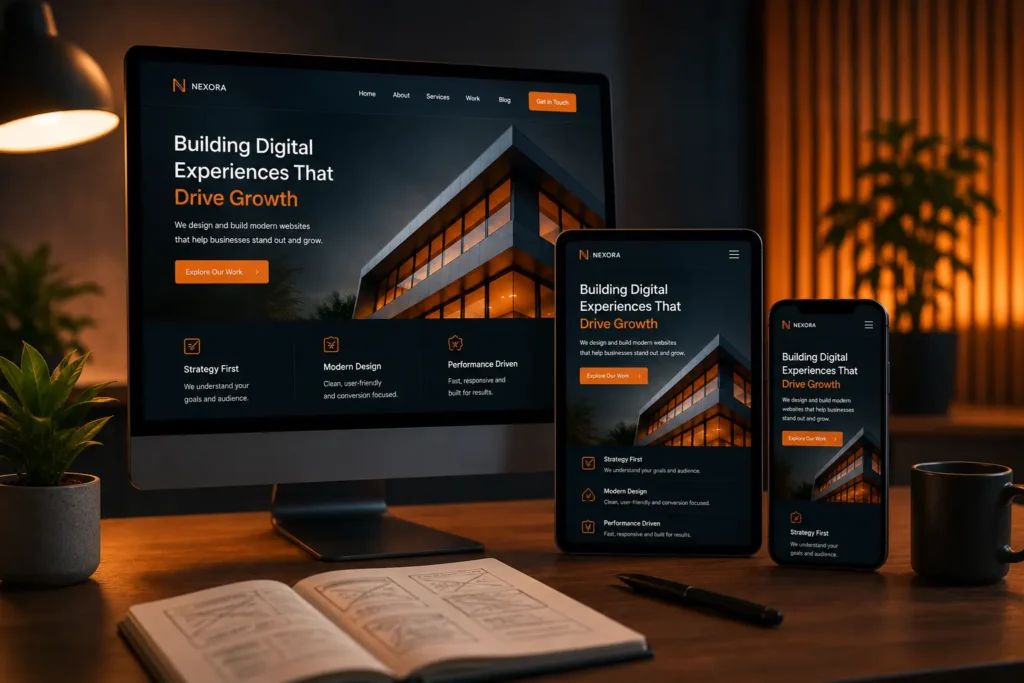
A responsive website adapts its layout to different screen sizes so that the experience remains usable across desktops, tablets and smartphones.
But responsive design is more than shrinking a desktop layout.
The mobile experience may require different spacing, navigation patterns, button sizes, image treatments and content priorities.
For example, a navigation menu that works perfectly on a large desktop screen may need to become a compact mobile menu.
A three-column service section may need to become a single-column layout.
A large desktop hero section may need to be simplified for smaller screens.
This is why responsive design should be considered during the design process rather than added as an afterthought.
7. Website Speed Is Part of the User Experience
Beautiful design does not matter much if visitors have to wait for the website to load.
Large images, unnecessary animations, excessive scripts, poorly optimised videos and too many third-party integrations can all affect website performance.
When a website feels slow, users become frustrated.
They may leave before reading the content or completing an enquiry form.
This is why website performance should be considered during the design stage.
For example, a designer can make decisions about image dimensions, animation usage, video placement and page structure that make development and optimisation easier later.
Google’s Core Web Vitals framework evaluates important aspects of page experience, including loading performance, responsiveness and visual stability.
This means website design and website performance should not be treated as completely separate disciplines.
The best websites are designed to look good and work well.
8. Consistent Design Makes a Brand More Memorable
Imagine a company using one font on its website, another font on Instagram, completely different colours on its presentations and a different visual style in its advertisements.
Even if every individual design looks good, the overall brand can feel disconnected.
Consistency helps create recognition.
Your website should therefore reflect the wider identity of your brand.
Typography, colours, imagery, icons, buttons, photography and visual language should work together.
This is particularly important for businesses investing in branding.
A website should not feel like something created separately from the brand identity.
Instead, it should become one of the strongest expressions of that identity.
This is where website design and branding come together.
A strong brand identity tells people what your business represents.
A strong website design translates that identity into an interactive digital experience.
9. Good UX Reduces Friction
Imagine wanting to contact a company but being unable to find its phone number.
Or trying to book a consultation and having to complete a form with fifteen unnecessary fields.
Or looking for pricing information but having to click through six different pages.
These are examples of friction.
Every unnecessary step increases the chance that someone will leave.
Good website user experience focuses on removing these obstacles.
Navigation should be predictable.
Forms should be simple.
Important information should be easy to find.
Buttons should communicate what happens when someone clicks them.
Pages should load without unnecessary delays.
Users should not have to learn how your website works.
The website should work in a way that feels familiar to them.
This is one of the biggest differences between simply designing a website and designing an experience.
10. Good Website Design Can Support SEO
SEO and website design are often treated as two completely separate activities.
They shouldn’t be.
The structure and design of a website can influence how easily users and search engines understand its content.
Clear heading structures help organise information.
Descriptive navigation helps users understand where they are.
Fast-loading pages create a better experience.
Mobile responsiveness supports users on smaller screens.
Internal links connect related pages.
Descriptive image alt text provides context for meaningful images.
Well-structured service pages can target specific search intent.
A good SEO strategy therefore becomes much easier when the website has a strong underlying structure.
For example, a company offering several services should not necessarily put every service into one giant page.
Individual service pages can provide more focused information for users while creating opportunities to target relevant search queries.
This is particularly useful for business website design because the website can simultaneously act as a brand platform, sales tool and organic search asset.
What Makes a Website Look Professional?
There is no single formula for professional website design.
A website does not automatically become premium because it uses gradients, animations, oversized typography or dark backgrounds.
Professional design comes from making intentional decisions.
Typography should match the brand.
Colours should create appropriate contrast.
Images should feel relevant.
Spacing should create rhythm.
Content should be organised.
Buttons should be consistent.
Animations should have a purpose.
The website should feel cohesive from the first page to the last.
Most importantly, the design should make sense for the audience.
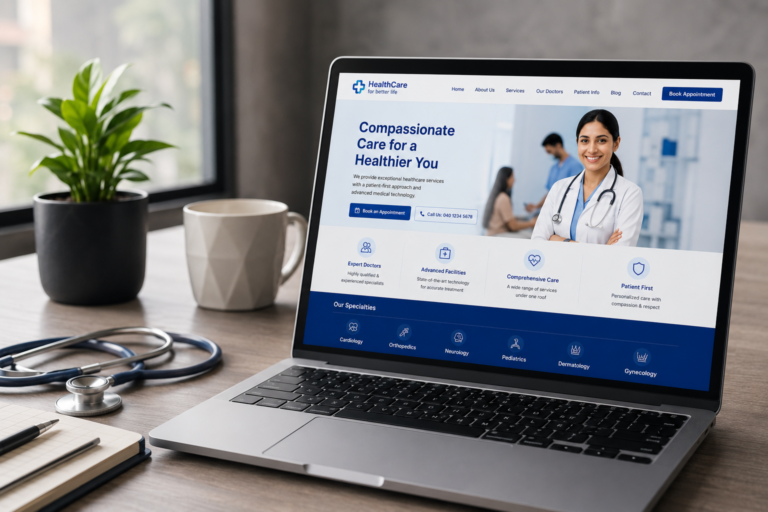
A luxury fashion brand, an engineering company, a healthcare business and a technology startup should not all have identical websites.
Good design starts with understanding the business and its audience before deciding what the website should look like.
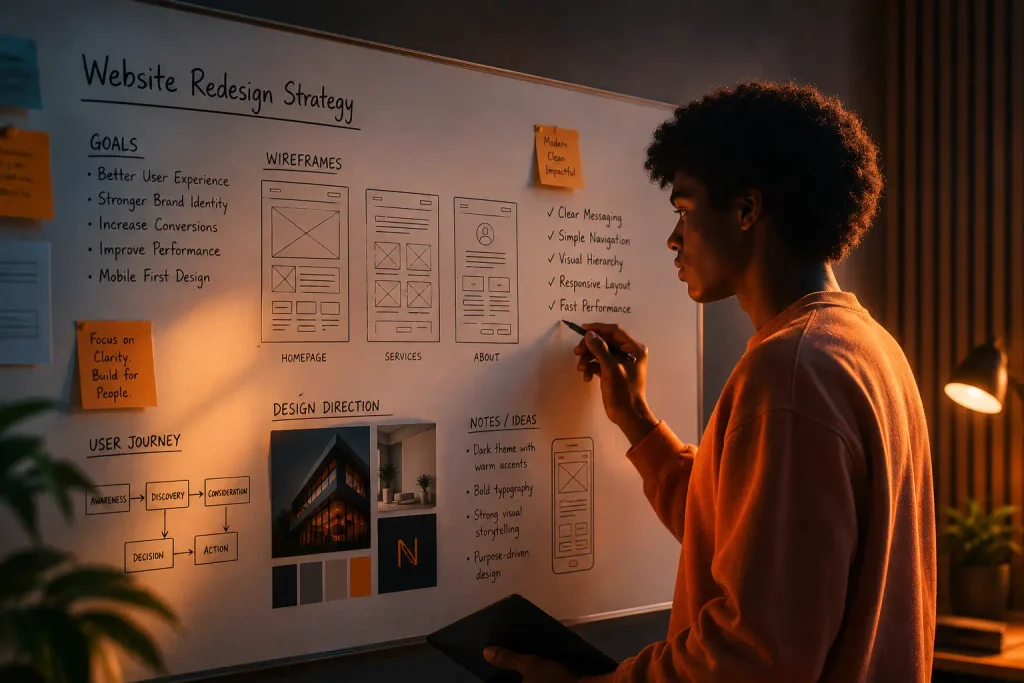
Website Design Should Start With Strategy, Not Decoration
One of the biggest misconceptions about web design is that the process starts by opening Figma and designing a homepage.
It shouldn’t.
Before visual design begins, there should be a clear understanding of the business.
Who is the target audience?
What problem does the business solve?
What makes it different?
What does the visitor need to know?
What action should the visitor take?
What pages are required?
What content needs to be created?
What keywords and search intents matter?
What existing brand guidelines need to be followed?
Once these questions are answered, the visual design has a much stronger foundation.
This approach also makes website redesign projects more effective.
Instead of simply changing colours, fonts and images, a redesign can address the deeper problems affecting the current website.
Website Redesign Should Solve Problems, Not Just Change the Look
A website redesign is sometimes treated as a visual makeover.
New colours.
New fonts.
New animations.
New homepage.
Done.
But if the original website had poor navigation, unclear messaging, slow loading times or weak conversion paths, changing the visual style alone won’t solve the underlying problems.
A successful website redesign should investigate why the existing website isn’t performing as expected.
Are visitors finding the information they need?
Are users abandoning forms?
Are mobile users experiencing problems?
Are important services difficult to discover?
Are visitors reaching the contact page?
Is the brand positioning clear?
Once these questions are understood, the redesign can focus on improving the actual experience.
The result should not simply be a website that looks newer.
It should be a website that works better.
Good Design Is About More Than Looking Good
This is perhaps the most important point.
A website can be visually impressive and still be a bad website.
It can have beautiful animations but confusing navigation.
It can have stunning photography but unclear messaging.
It can have sophisticated interactions but take five seconds to load.
It can have an impressive homepage but no clear path towards contacting the business.
The best websites balance aesthetics with usability.
They look good because they are well designed, but they also perform a practical job for the business and its customers.
That is the real purpose of good website design.
Final Thoughts
Your website is more than a digital business card.
It is often the place where potential customers first discover your business, evaluate your credibility, understand your services and decide whether they want to contact you.
That makes website design a business decision, not simply a visual one.
Good website design creates clarity.
It builds trust.
It improves usability.
It supports branding.
It makes information easier to understand.
It can improve conversions.
It can support SEO.
And most importantly, it creates a better experience for the people your business is trying to reach.
If your current website feels outdated, difficult to navigate or disconnected from the quality of your actual business, a redesign may be more than a visual upgrade. It can be an opportunity to rethink how your brand communicates and how customers experience your business online.
At Hiteshigarg.in, the focus is on creating websites that combine thoughtful visual design, clear communication and practical user experience rather than simply following design trends.
Whether you are launching a new business website or planning a complete website redesign, the right design should make your business easier to understand, easier to trust and easier to choose.